The owned, earned and paid model still holds in 2026, but each part now does a different job. What changed, and the order worth fixing them in.
The owned, earned and paid model has been in use for well over a decade, which in marketing is long enough for a framework to become wallpaper. Everyone nods at it. Almost nobody re-examines what each of the three is actually doing now.
It is worth re-examining, because the definitions have quietly moved. What sits in each bucket in 2026 is not what sat there when the model was first drawn up, and budgets built on the old definitions are misallocated in fairly predictable ways.
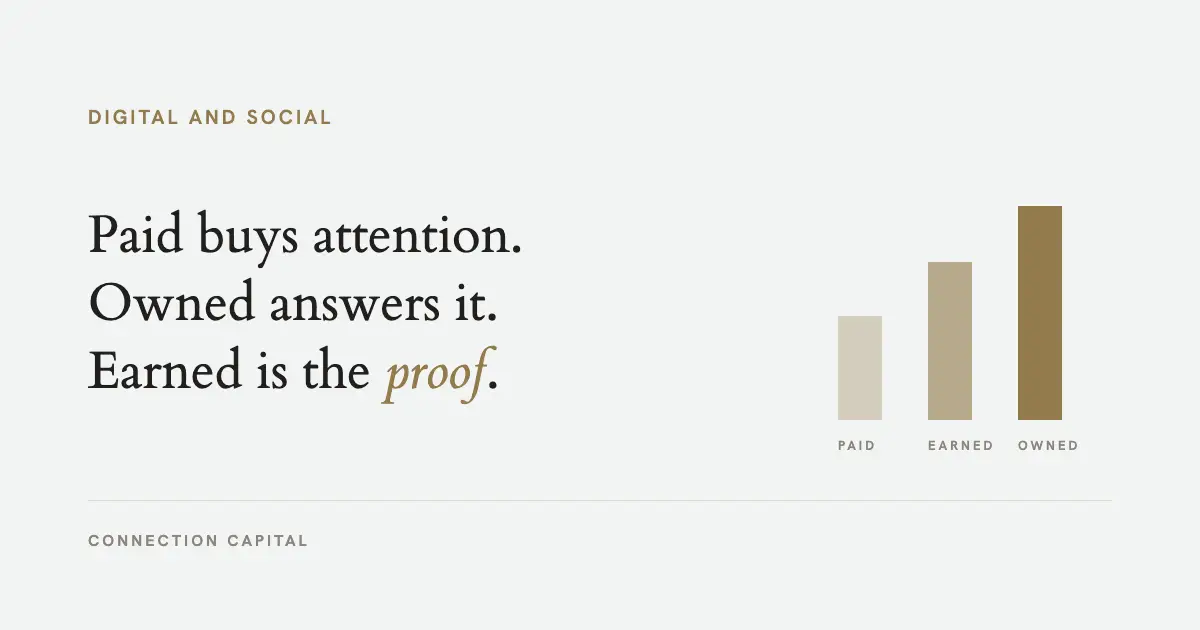
A quick refresher before the update. Owned is what you control outright. Earned is what others say about you. Paid is what you buy. The relationship between them is the whole point: paid buys attention, owned answers the question that attention created, and earned decides whether the answer is believed.
Owned in 2026: your machine-readable record
Owned used to mean your website, your email list and your social profiles, and the advice was essentially to keep them tidy and current.
Two things changed that.
The first is that your website now has two audiences. One is human. The other is the set of search engines and AI assistants that read your site and then answer questions about you, on your behalf, to people who may never visit. A growing share of research now ends without a click. The question still gets answered. Your site is simply the raw material rather than the destination.
That has a practical consequence. Content that is hard for a machine to parse is content that is absent from the answer. Service pages written in industry abstraction, prices hidden behind an enquiry form, key facts locked inside images or PDFs, no structured data, no clear headings. All of it reads fine to a person who has already arrived and is useless to the system deciding whether to mention you at all.
The second change is that your database matters more than it did. Organic reach on social has declined for years and advertising costs have risen. The list of people you can contact directly, without paying an intermediary or asking an algorithm politely, has gone from a nice-to-have to the most valuable marketing asset most businesses hold.
So owned in 2026 is not “our website and our socials”. It is the authoritative, machine-readable record of what your business does, plus a direct line to the people who care.
Earned in 2026: proof, not press
Earned media used to mean coverage. A journalist wrote about you, and the value came from the masthead’s authority.
That still exists, and it is still good when you can get it. But it is no longer where most earned value sits for a small or medium business, for two reasons: media is far more fragmented, and buyers now do their verification somewhere else entirely.
Earned today is mostly proof.
Reviews and ratings, above all. For most local and service businesses, the volume, recency and specificity of reviews is the single highest-leverage earned asset available, and the one most consistently neglected. It is not unusual to find a business with a decent website, a sensible ad budget, and almost no reviews, which is the marketing equivalent of a good shopfront with the lights off.
Then: mentions and citations elsewhere. Industry directories, association listings, partner sites, podcasts, local media, creators, community groups. These do double duty, because they are also part of what search engines and AI assistants draw on when they describe you. Being consistently described in the same terms in several credible places is how a summary of your business becomes accurate.
And referrals, which remain the highest-converting channel almost every business has and the one least often given a deliberate process.
Earned is not free. It is unpaid, which is different. It costs attention, follow-up and a system for asking.
Paid in 2026: a sharper tool, in a narrower role
Paid has become both more expensive and less precise.
Privacy changes across browsers, devices and regulation have reduced the signal advertising platforms can use to find and measure individuals. Platforms have responded with modelling and automation, which works reasonably well but moves control away from the advertiser. Meanwhile more advertisers are competing in the same auctions, and costs have gone one way.
The practical effect is that the two levers that still reliably move paid performance are the offer and the creative. Targeting is increasingly something the platform does, given a budget and a signal. What you feed it, and what the ad actually says, is the part still under your control.
The second effect is more strategic. Paid is very good at buying attention you have not yet earned. It is very bad at manufacturing belief. Send paid traffic to a thin website with no proof and you have bought an expensive look at a reason to hesitate.
Which means paid works best when owned and earned are already in place. That is the reverse of how most budgets get built, because paid is the only one of the three that can be switched on in an afternoon.
How the three compound
Paid buys the first look. Owned answers the question that look created. Earned removes the remaining doubt. The customer arrives, and from then on the cycle repeats with less paid in it, because familiarity has done part of the work that money was previously doing.
That compounding is the actual argument for the model. The three are not three budget lines competing for the same dollar. They are a sequence in which each part makes the next one cheaper.
On split, the most durable guidance remains the brand-building and activation balance popularised by Binet and Field: roughly sixty per cent of effort on the long-term work that builds familiarity, forty per cent on the short-term work that converts current demand. Treat it as a direction rather than a formula. The common error is not getting the ratio slightly wrong. It is running at something closer to ten and ninety, and concluding that marketing does not work.
A health check
Five questions, in the order worth fixing them.
- If someone asks an AI assistant what your business does, is the answer correct? If not, your owned media is not readable enough.
- Is every service you sell on a page of its own, in the words customers use?
- How many reviews did you receive in the last ninety days, and who is responsible for asking?
- Can you email your customers tomorrow without paying anyone for the privilege?
- Is your paid spend pointing at pages that would convince a sceptic?
If any of the first four is a no, that is where the next dollar goes. Paid will still be there next month, and it will work considerably better once the other two are ready for it.
If you are not sure which of the three is the weak link in your business, that is usually the first thing worth diagnosing.
Start a conversation